


Business Analysis Training Courses for Professionals
According to the International Institute of Business Analysis (IIBA®), Business Analysts are responsible for identifying the needs of their clients and stakeholders to determine solutions to business problems. The Essential Business Analysis Skills are:

Why Your Company Needs Business Analysis Training
- 66% of software projects aren't expected to finish on time or on budget
- 56% of project defects originate in the requirements phase of the project
- Completed projects have only 52% of proposed functionality
When you bring RG Freeman Group's business analysis training in-house, you give your team members the tools and knowledge they need to streamline projects and improve your bottom line. Your analysts will have the knowledge to improve communication between business stakeholders and developers in order to:
Learn more about business analysis training from RG Freeman Group and how we can help you and your organization become more efficient, effective, and profitable.
Who Should Take Business Training Courses?
 We offer complete breadth and depth courses for the entire enterprise organization, from beginner to advanced level courses for senior management.
- Self-taught business analysts requiring a course that fills in the gaps and puts all the pieces together
- Systems analysts and programmers interested in expanding their role into the business area
- Quality assurance professionals
- Project managers
- Solution architects
No matter what organization or title owns the function, the business analyst's primary responsibilities are gathering requirements for designing business information systems, modifying systems to improve production or workflow, deploying new applications, or expanding systems to serve new purposes.
Business Analysis Knowledge Areas:
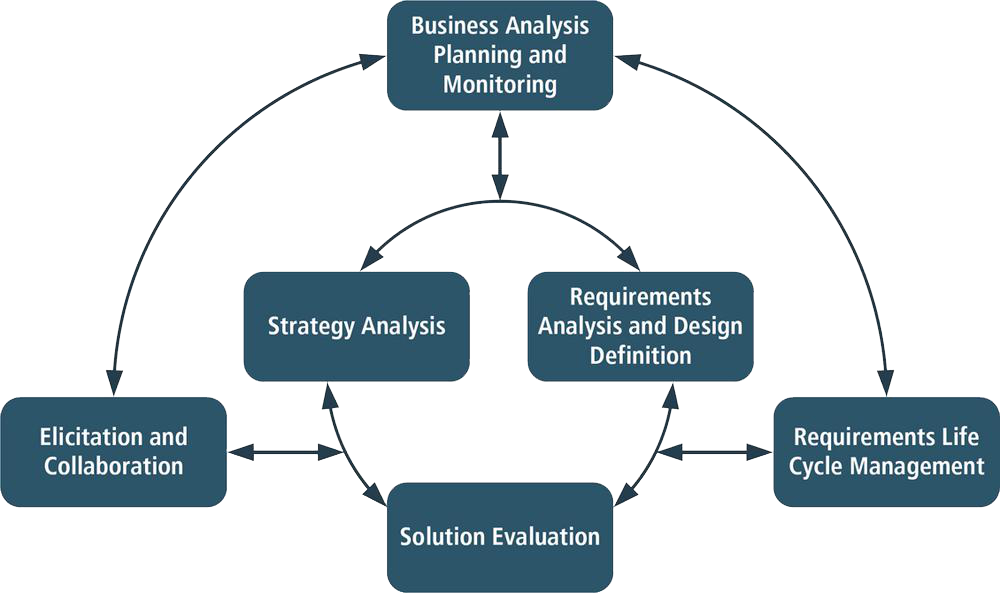
BABok v3 Quick Reference of Knowledge Area Tasks and Underlying Competencies
Business Analysis Training--Core Program
RGF-BA01 Business Analysis Essentials -- 2 days
This is an introductory course designed to provide participants with a basic understanding of the benefits, functions, and impact a business analyst has within an organization. The course discusses the process as it is applied throughout a project. This includes the pre-project activities that comprise Enterprise analysis and how a business analyst supports the project throughout the solution development life cycle, from establishing the solution vision and scope in the analysis phase to validating that requirements have been met in the testing phase. Upon completion, you understand why and when to involve the business analysis function. They also have a working vocabulary to enable The Business Analysis Body of Knowledge® (BABOK® Version 3.0)
RGF-BA30 Foundations of Business Analysis -- 4 days
Why do more than 50% of projects fail to meet their original objectives? Why do we continue to see the number of troubled and canceled projects on the rise? According to PMI’s “Pulse of the Profession® In-Depth Report,” 47% of failed projects fail to meet goals due to poor requirements management [1]. With a strong correlation between poor requirements practices, failed projects, and wasted dollars; organizations can no longer afford to accept mediocre business analysis skills. This course provides a clear understanding and total immersion into all of the facets of the business analyst role, including a thorough walkthrough of the various domain/knowledge areas that comprise the profession. You can try several techniques for eliciting, analyzing, and modeling requirements. The work performed in strategy analysis and solution evaluation, which is most often the least familiar to business analysts, is thoroughly presented and explored. You end up equipped with new skills and knowledge that can be immediately applied on current and future projects.
The course is aligned to BABOK Version 3 and covers the IIBA knowledge areas on the Entry Certificate in Business Analysis (ECBA) exam.
Course Objectives:
This course intends to provide beginner and intermediate students a total immersion into the business analyst role by exposing attendees to the various aspects of the profession and numerous techniques to allow them to improve elicitation, analysis, and documentation of requirements. This course is compliant with IIBA’s Business Analysis Body of Knowledge (“BABOK® Guide”) Version 3 and is aligned with and upholds the practices as discussed in “PMI’s Business Analysis for Practitioners: A Practice Guide.” These 5 core courses can be taken a la carte, or together they comprise the RG Freeman Group BA Certificate Program.
Business Analysis Training--Electives
 RGF-BA02 Strategic Business Analysis -- 2 days
Learn about the components of strategic business analysis. Understand the criticality of defining the business need correctly and pursuing a thorough analysis of the internal and external environments of the Enterprise before choosing the solution. Shortcutting the pre-analysis work discussed in this course often results in delivering solutions that are misaligned to the Enterprise strategy and to the expectations and needs of the business. Learn how to avoid the pitfall of jumping to a solution prior to a solid understanding of the opportunity or problem needing to be addressed.
RGF-BA03 Writing Effective Business Cases -- 2 days
The one course you need to make high-impact recommendations and receive full management support for your ideas. Learn the steps to effective business case development and support your strategic recommendations with sound budgeting and financial back-up. This skills-intensive workshop is ideal for experienced managers, directors, and corporate officers who regularly develop and present budgets, business plans, and recommendations.
RGF-BA04 Eliciting and Writing Effective Requirements -- 3 days
Successful projects are built on the foundation of well-written requirements. You learn to identify your audience, determine their requirements, and provide them with adequate and appropriate information. You learn the technical writing techniques that apply directly to writing requirements documents and to apply the five C’s of writing: correct, clear, concise, comprehensive, and cohesive. This course covers the "Requirements Documentation" knowledge area of the Business Analysis Body of Knowledge (BABOK®).
RGF-BA05-BP Business Process Modeling -- 2 days
Learn to map your business processes easily and efficiently using examples and industry practices. You will learn the best practices in process mapping using the latest industry standards so that both the business and IT stakeholders will be able to understand the models and map processes consistently through-out your organization.

RGF-BA08 Agile for Business Analysts -- 2 days
In this course, you develop your understanding of Agile business analysis and the role of the business analyst on an Agile team. You learn how business analysis on an Agile project differs from Waterfall projects. A number of business analysis techniques suited for supporting Agile teams are introduced alongside various standards available to the community to help teams and organizations transition. Since few organizations are purely Agile, you learn about delivery approaches that use a combination of practices from Waterfall and Agile and are also introduced to the important concept of business analysis tailoring--the key skill used to adapt to all environments--regardless of the delivery life cycle selected.
Added Bonus--Support for Pursuing Your IIBA® AAC Certification
Since demonstrating your Agile competencies is important when pursuing your next role on any Agile team, this course introduces the newest Agile analysis certification in the marketplace IIBA-AAC. The IIBA-AAC credential enables you to identify yourself as someone who has mastered a firm understanding of Agile business analysis and has acquired a few years of experience in the process.
You get important information that defines the credential, explains the experience required to apply for the exam, the exam structure, its costs, a thorough overview of what the exam covers, and what you need to understand to prepare for it. You may not have considered obtaining an Agile certification before, but should you decide, this course provides all of the information you need to start your studies.
RGF-BA09 Managing Requirements for SharePoint Projects -- 2 days
Requirements can change frequently during a SharePoint project, and therefore projects need a streamlined, flexible approach to requirements change management. SharePoint professionals want to develop systems and services which are both high-quality and high-value, and the easiest way to achieve this is to implement the highest priority requirements first. This enables the projects to maximize value for their stakeholders. The course explores how to manage requirements for an effective SharePoint environment.
RGF-BA10 Understanding Root Cause Analysis -- 2 days
Root Cause Analysis (RCA) is a structured, team-based, analytical approach. When used correctly, RCA can alleviate recurring problems within an organization. In this course, you learn to apply several practical, systematic methods for analyzing incidents and problems to uncover root causes. Understanding of these techniques is reinforced by exercises as we explore effective ways of gathering data for root cause analysis and how to determine which problems should be analyzed. We also discuss how to design, develop, and implement a root cause analysis program for your organization.
RGF-BA17 Problem Determination Root Cause Analysis (RCA) -- 2 days
This 2-day course is aimed at experienced people who have more practice with root cause analysis. Business success is dependent on effective resolution of everyday problems. Often the same or similar problems continue causing repeated losses in time or money, and your staff becomes experts at fixing rather than preventing them. Learn to find and fix root causes and develop corrective actions that eliminate or control these problems.
Learning Objectives:
- Identify the different types of tools and techniques available
- Apply change management successfully
- Review what to look for when applying business case thinking to root cause analysis
- Develop a process to approach problems systematically
RGF-BA20 Business Process Improvement (BPI) -- 2 days
This course is suitable for both novices and experienced people who need to manage and implement a Business Process Improvement (BPI) initiative. Having an understanding of project management and business processes is helpful and recommended. This 2-day course aims at introducing its attendees to BPI core values, principles, and practices.
Business Process Improvement Learning Objectives:
- Describe business process improvement (BPI) business drivers.
- Plan, manage and close requirements for a Business Process Improvement project.
- Understand the essential elements of a successful BPI initiative.
- Identify candidate business processes for improvement.
- Understand the essential elements of a successful BPI initiative.
- Identify candidate business processes for improvement.
- Apply a methodology to business process improvement projects.
RGF-BA26 Requirements Elicitation -- 2 days
Strong elicitation skills are a “must have” for anyone charged with defining requirements for their project. Success is dependent on a mixture of technical skills (knowing which technique to use and how to use it) and interpersonal skills (building relationships, listening, and gaining consensus). Whether you plan to meet with your stakeholders in one-on-one sessions, in a requirements workshop, or remotely, you need to know how to select and implement techniques to identify your business needs.
In this highly interactive 2-day course, you learn how to enhance and refine your elicitation skills. Industry best practices are explained and then augmented with professional tips and methods. Working in small groups, you practice new techniques and discuss strategies that your organization should be using to define stakeholder needs better. A case study-driven workshop comprises more than half the course and provides a real-world example, templates, and job aids to reference once you are back on the job. If you are struggling with missing requirements, lack of stakeholder involvement, or out of control scope, you'll want to consider this workshop.
By taking this workshop, participants can:
- Apply best practices to resolve common problems encountered in requirements elicitation
- Establish and communicate the scope for eliciting requirements on a project
- Identify, analyze and manage stakeholders during the elicitation process
- Determine the appropriate mix of elicitation techniques to utilize on a project
- Plan and conduct an interview to elicit requirements
- Plan and conduct several different types of facilitated sessions
RGF-BA27 Writing and Managing Effective Requirements -- 3 days
Successful projects are built on the foundation of a clearly defined business need and well-understood requirements. This course provides a clear understanding of all the facets of the business analysis role, including a thorough walkthrough of the various domain/knowledge areas that comprise the profession. You get to try several techniques to assist with improving your skills in stakeholder identification, scope definition, and analyzing, documenting, and modeling requirements.
Writing and Managing Effective Requirements Course Objectives:
- Obtain a thorough understanding of the core responsibilities of the business analyst
- Understand the main professional associations and standards supporting business analysts in the industry
- Discuss and explore the components of each of the domains/knowledge areas that comprise the work of business analysis
- Obtain a clear understanding of the various requirements types and the significance for eliciting each type
- Discuss requirements packages and types of requirements documentation
- Obtain hands-on experience with a number of business analysis techniques and models
RGF-BA28 Requirements Analysis and Documentation -- 2 days
This 2-day course provides a strong foundation in the mechanics of use case diagramming and writing textual descriptions of use cases. In this highly interactive workshop, you will learn how to enhance and refine your use case skills, how to involve your stakeholders in the use case process, and how to develop use cases that provide valuable information to the designers and testers. Use cases that meet the needs of designers can be too technical and too detailed for other stakeholders. Use cases that satisfy business users are usually not very helpful to designers and testers. How do you satisfy these two disparate interests? And how do you handle the details like business rules, data validations and user interface specifications?
RGF-BA29 User Acceptance Testing (UAT) for Business Analysts (BAs) -- 2 days
All too often the software products delivered to the business do not meet their expectations, especially with regard to the quality of the product. An effective User Acceptance Testing (UAT) process addresses this issue by confirming the functionality and performance of the product prior to its release. This one-and-a-half or 2-day workshop looks at the business issues which drive the need for a fully functional UAT process and describes its components. It is designed to help the Business Analyst (BA) develop an understanding of their role, the process, and the deliverables associated with UAT.
User Acceptance Testing (UAT) for Business Analysts Objectives:
- Develop an understanding about basic concepts associated with User Acceptance Testing
- See how UAT applies to the Software Development Lifecycle (SDLC)
- Recognize the benefits of improved quality of deployed software using User Acceptance Testing
- Identify the key roles, activities, and deliverables which make up User Acceptance Testing
- Use a Business Use Case to define scenarios for testing; create a UAT test plan and write UAT test cases with associated test data
- Understand the process for testing functional and non-functional requirements; identify the challenges of testing vendor-supplied application
RGF - BA31 The Unified Modeling Language (UML) for Business Analysts (BAs) 4 Days
This course will provide Business Analysts with new capabilities to improve their skills with using visual modeling techniques to document requirements. The use of the Unified Modeling Language will significantly improve the way that requirements are elicited, analyzed, documented, and verified.
This course is based upon not only the latest OMG standards related to UML, but also it’s application on projects in various commercial and government domains.
The course is designed for Business Analysts who need a practical, applied, and comprehensive understanding of using visual modeling techniques for capturing requirements. It is targeted for those who contribute to the development of requirements using UML, but is also appropriate for anyone wanting a basic understanding of the primary techniques which use graphical modeling as a way of analyzing and documenting requirements.
RGF-BA32 - The Unified Modeling Language (UML) for Developers Workshop – 1 Day
This course will provide developers with an understanding of the UML diagrams which are used to analyze and capture requirements graphically during the Enterprise Analysis phase of the project. Emphasis will be placed on the proper usage of UML notation to correctly convey the meaning of the data, behavior, and interface requirements.
This course is designed for developers who are interested in learning how to use the UML as a graphical modeling technique for defining, analyzing, and capturing requirements visually.
RGF-BA39 - Software Testing Workshop – 2 Days
All too often the software products delivered to the business do not meet their expectations, especially with regard to the quality of the product. An effective testing process addresses this issue by confirming the functionality and performance of the product prior to its release to the business.
This two day class looks at the business issues which drive the need for a fully functional testing process and describes the components of such a process. It is designed to help the testers develop an understanding of their role, the process, and the deliverables associated with testing.
Business Analysis Immersion Course
RGF-BA30 Foundations of Business Analysis - 4 days
This course provides a solid foundation in the principles, practices, and techniques of business analysis, aligned with the IIBA® BABOK® Guide and ECBA® exam blueprint. Participants will gain practical skills to identify business needs, define solutions, collaborate with stakeholders, document requirements, and support organizational change. Through lectures, discussions, case studies, and hands-on workshops, participants will build confidence in applying analysis methods while preparing for the ECBA® exam.
RGF-BACP02 Certified Business Analysis Professional (CBAP®) and Competency in Business Analysis (CCBA®) Exam Preparation - 4 days
An intensive review of the materials covered on the IIBA® Certified Business Analysis Professional (CBAP®) and Competency in Business Analysis (CCBA®) Exam. With a focus on the BABOK® V3.0, this course is designed to provide participants with a clear understanding of the concepts covered within the CBAP® and CCBA® exams. The course provides valuable tips and techniques to help students prepare, study, and assess their personal readiness.
RGF-PBA04 PMI Professional in Business Analysis (PMI-PBA®) Exam Preparation - 4 days
This course provides an in-depth review of the business analysis knowledge, skills, and tasks as discussed in the PMI standard “Business Analysis for Practitioners: A Practice Guide.” The material within this course provides a solid overview of the activities commonly performed by those fulfilling the business analysis role on programs and projects. The course is intended to prepare students who are interested in taking the PMI-PBA® exam.
Professional in Business Analysis Learning Objectives:
Upon completion of this course, participants will be able to:
- Identify the business analysis tasks discussed in “Business Analysis for Practitioners: A Practice Guide”
- State the importance of the 5 business analysis domains covered by the PMI-PBA®
- Assess readiness for taking the PMI-PBA®
- Prepare effectively for the exam
- Identify other sources to assist in preparing for the PMI-PBA®
- Complete the application process
Business Analysis Training White Papers and Templates
- Business Analysis Competency Development Workbook
- IIBA - The Business Analysis Standard
- 13th Annual State of Agile Report
- Power BA Program + BABOK v3 Illustration
- Quick Reference Requirements Elicitation
- Quick Reference Requirements Analysis and Use Cases
- Whitepaper: User Acceptance Testing (UAT) for Business Analysts (BAs)
- RG Freeman Group BA and Agile Training Program Roadmap
- One page illustration of all the parts to an Agile Scrum 2-4 week sprint
- 7 Steps to Business Process Improvement (BPI)
- BPI - Joiner 7 Steps Template
- Whitepaper: How requirements can greatly improve the selection and integration of Commercial-off-the-shelf (COTS) products
RG Freeman Group Business Analysis Webinar Series
BA-WEB01--How Business Analysts Provide Value in Today's Work Environment
In this webinar, we introduce you to how business analysis can contribute to strategic, project, and organizational success. We cover the following topics:
- Growth in the interest in the business analyst
- The International Institute for Business Analysis (IIBA)
- The role of the business analyst and how this role works with others during the project cycle
BA-WEB02--10 Components to Designing a Business Model
Every part of every organization, public or private, large or small, uses a business model. Having a proper understanding of your business model, what it provides, to whom and how, is critical to an organization achieving its desired outcomes.
In this webinar, we introduce you to building an effective business model that defines how the organization delivers value to customers and entices them to pay for that value. We cover the following topic areas:
- Understanding the organization’s desired outcomes
- The service and product offerings to support those outcomes
- The infrastructure necessary to execute the business model
- The target audience for the products and service and how they are delivered
- The financial structure of the business model
BA-WEB03--The Skills Required for Business Analysts to Manage Stakeholders Expectations
A key element of a business analyst’s proficiency is awareness of the array of techniques, tools, and deliverables that are available and selecting the ones appropriate to a particular problem. The business analyst collaborates with stakeholders throughout the organization to ensure high quality, on-time deliverables and seamless communication. In this webinar, we introduce you to the essential skills, covering the following topic areas:
- Analyze and understand the business problems
- Identify and document requirements
- Communicate effectively (written and spoken)
- Manage client relationships
- Model data and processes
- Facilitate and develop business strategy
- Understand and manage organizational change
BAPM-WEB04--How to Successfully Implement an Agile Project
Many of today’s project management and business analyst professionals are finding themselves leading, managing, and analyzing on Agile development teams--only to find that many of the tools and techniques applied when using a traditional project management approach no longer work as effectively or at all. In order to do more than survive in this iterative development environment, today’s project manager and business analyst must employ additional tools and techniques to lead teams and deliver projects.
- This webinar introduces how your projects can easily and successfully make the transition to an Agile environment. Agile Scrum is an incremental, iterative framework for project management and software development where requirements and solutions evolve through collaboration between self-organizing, cross-functional teams.
BAPM-WEB05--Managing a Project with Your Team
Anyone who has managed a complex project knows that the Lone Ranger is a myth. Nothing gets done in modern organizations by the force of one person. Projects in today’s rapidly evolving organizations require engaging a broad set of stakeholders and a capable project team. In those fast-paced environments, no challenges are greater than motivating a team that’s probably already overwhelmed with responsibilities and stressors and managing the heightened levels of conflict that are natural in tough, highly visible projects.
- Webinar Objectives: In this webinar, we introduce you to the essential communication skills required for project managers and business analysts. You get a model for explaining how the current world of work is shifting and models for managing team conflict and dealing with the emotions of team members and stakeholders.
PM-WEB06--Dealing with Projects Before They Become Issues
Project managers realize they must manage risks and issues in a timely and effective manner. However, many teams do not practice effective and continuous risk management throughout the project life cycle, preferring to wait until the risk becomes realized before taking any action. This presentation discusses the differences between project risk management and issues management and reviews some tools and best practices that make both jobs more effective. It also covers some techniques and recommendations for applying them. The webinar presentation shows the difference between risks and issues. We cover how to best develop the mindset and attitude to deal with them and learn risk management best practices as well as tools and techniques.
To find out more about the RG Freeman Group business analysis training programs, contact our team today.
